
Disclaimer for VIN DETAILS INFO
If you require any more information or have any questions about our site's disclaimer, please feel free to contact us by email at [email protected]. Our Disclaimer was generated with the help of the Free Disclaimer Generator.
Disclaimers for VIN Details Info
All the information on this website - - is published in good faith and for general information purpose only. VIN Details Info does not make any warranties about the completeness, reliability and accuracy of this information. Any action you take upon the information you find on this website (VIN Details Info), is strictly at your own risk. VIN Details Info will not be liable for any losses and/or damages in connection with the use of our website.
From our website, you can visit other websites by following hyperlinks to such external sites. While we strive to provide only quality links to useful and ethical websites, we have no control over the content and nature of these sites. These links to other websites do not imply a recommendation for all the content found on these sites. Site owners and content may change without notice and may occur before we have the opportunity to remove a link which may have gone 'bad'.
Please be also aware that when you leave our website, other sites may have different privacy policies and terms which are beyond our control. Please be sure to check the Privacy Policies of these sites as well as their "Terms of Service" before engaging in any business or uploading any information.
Consent
By using our website, you hereby consent to our disclaimer and agree to its terms.
Update
Should we update, amend or make any changes to this document, those changes will be prominently posted here.
Tata VIN Decoder — The Complete Guide for Indian Vehicle Owners
Everything you need to know about reading, decoding, verifying and trusting a Tata Vehicle Identification Number — for cars, SUVs, sedans, hatchbacks, electric vehicles, trucks, buses and commercial vehicles. This guide is written for Indian buyers, sellers, dealers, insurers and fleet operators who want a single, reliable reference for Tata VIN decoding.
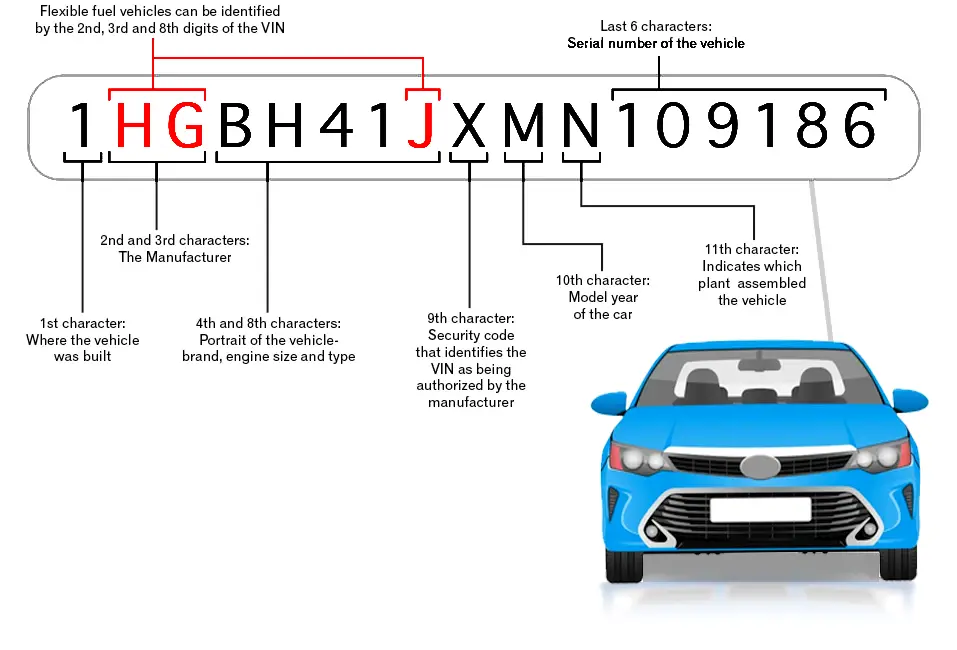
1. What Is a VIN and Why Every Tata Owner Should Know It
A Vehicle Identification Number — universally shortened to VIN — is a unique 17-character alphanumeric code assigned to every motor vehicle at the moment it rolls off the assembly line. Think of it as the vehicle's fingerprint: no two VINs in the world are the same, and once a VIN is assigned to a chassis, it stays with that vehicle for life. In India, the VIN is a legal requirement under the Central Motor Vehicles Rules (CMVR) and is standardised by the international ISO 3779 specification.
For Tata owners — whether you drive a Nexon, Harrier, Safari, Tiago, Tigor, Altroz, Punch, Curvv, Nexon EV, or a Tata Ace, Intra, Prima truck, or Starbus — the VIN is the single most important identifier used by the RTO, insurance companies, banks, police and the Ministry of Road Transport and Highways (MoRTH) through the VAHAN database.
A Tata VIN is not a random string. Every character carries meaning. The first three characters tell you the country and manufacturer, the middle section encodes the model family, body style, engine and restraint system, and the last eight characters encode the model year, plant code and sequential production number. Once you understand this structure, you can verify any Tata vehicle in under 60 seconds — without paying a single rupee.
2. Anatomy of a Tata VIN — Character-by-Character Breakdown
Every modern Tata VIN follows the same 17-character ISO 3779 structure. Here is the position-by-position breakdown, using a typical Tata Nexon VIN as an example.
| Position | Section | Meaning | Tata Example |
|---|---|---|---|
| 1–3 | WMI | World Manufacturer Identifier — country + maker | MAT = Tata Motors, India |
| 4 | VDS | Vehicle line / model family | Varies by model |
| 5 | VDS | Body style and series | Varies |
| 6 | VDS | Engine / powertrain family | Varies |
| 7 | VDS | Restraint system | Airbags, seat belts |
| 8 | VDS | Gross vehicle weight / trim | Varies |
| 9 | Check | Check digit that validates the VIN | 0–9 or X |
| 10 | VIS | Model year | See year table below |
| 11 | VIS | Assembly plant code | Pune / Sanand / Jamshedpur / Lucknow |
| 12–17 | VIS | Sequential production number | Unique to that vehicle |
The Three Sections Explained
World Manufacturer Identifier (WMI — characters 1–3): The first three
characters tell you where the vehicle was built and by whom. Tata Motors uses the WMI
MAT, assigned by SAE International under the ISO 3780 standard. If a Tata
vehicle shows a WMI that is not MAT, either the VIN has been re-stamped
illegally, or the vehicle was built under a joint venture or CKD arrangement abroad.
Vehicle Descriptor Section (VDS — characters 4–9): This is the most manufacturer-specific part of the VIN. Tata Motors uses these six characters to encode the model family (Nexon vs Harrier vs Altroz), body style (hatchback, sedan, SUV), engine family (Revotron petrol, Revotorq diesel, Kryotec diesel, Ziptron electric), restraint system (airbag count), and gross vehicle weight class. The 9th character is a mathematical check digit that validates the entire VIN; if a single character is altered, the check digit will fail.
Vehicle Identifier Section (VIS — characters 10–17): The 10th character is the model year — the single most important character for used-vehicle buyers. The 11th character is the plant code. Characters 12–17 are the sequential production serial number. Because Tata Motors produces over 1 million vehicles per year across multiple plants, this number can go well above 100,000.
3. Tata Model Year Codes — How to Read the 10th Character
The 10th character of a Tata VIN tells you the model year. This is not always the same as the year of registration in India. A car built in December 2023 may be registered in January 2024 — meaning the VIN shows a 2023 model year, but the RC shows a 2024 registration. Always use the VIN's 10th character as the authoritative model year.
| Code | Model Year | Code | Model Year |
|---|---|---|---|
| L | 2020 | M | 2021 |
| N | 2022 | P | 2023 |
| R | 2024 | S | 2025 |
| T | 2026 | V | 2027 |
| W | 2028 | X | 2029 |
| Y | 2030 | 1 | 2031 |
Letters I, O, Q and U are never used
in a VIN to avoid confusion with the digits 1 and 0. If you see them in a "VIN", the
number is either fake or written incorrectly.
4. Where to Find the VIN on a Tata Vehicle
Depending on the model, the VIN on a Tata vehicle can be found in one or more of the following locations. Before you buy any used Tata, physically match the VIN in at least three of these locations.
4.1 Tata Passenger Cars and SUVs
- Engine bay / firewall: Stamped on the chassis behind the engine. This is the primary location for Nexon, Harrier, Safari and Altroz.
- Driver-side door jamb: A metal or sticker plate riveted to the B-pillar carrying VIN, GVW and tyre specs.
- Windshield lower corner: Visible through the glass on many modern Tata models — used for quick roadside checks.
- Under the front passenger seat: Etched on the floor pan on some Nexon and Punch variants.
- Registration Certificate (RC): Always cross-check the VIN printed on the RC against the physical chassis.
4.2 Tata Electric Vehicles (Nexon EV, Tiago EV, Tigor EV, Punch EV, Curvv EV)
- Battery pack frame: A secondary VIN plate on the high-voltage battery enclosure.
- Front motor mount plate: Stamped on the chassis near the electric motor.
- Door jamb sticker: Standard location, same as ICE models.
4.3 Tata Commercial Vehicles (Ace, Intra, Prima, Signa, Starbus, Ultra)
- Chassis frame rail: Stamped on the left-hand frame rail near the front axle.
- Cabin door jamb plate: Riveted metal plate with VIN, GVW and axle configuration.
- Engine bay firewall: Firewall-mounted plate on most Tata trucks.
- Body VIN: Some buses have a separate body VIN stamped by the body-builder.
5. Tata Model VIN Prefix Reference
While the VDS section (characters 4–9) is proprietary to Tata Motors, the following table shows typical WMI + model family combinations you will encounter when decoding Tata vehicles in India. Always rely on the actual decode result from our tool for accuracy.
| Model Family | Typical Engine | Fuel Type | Production Plant |
|---|---|---|---|
| Tata Nexon (Petrol) | 1.2L Revotron Turbo | Petrol | Pune / Sanand |
| Tata Nexon (Diesel) | 1.5L Revotorq | Diesel | Pune / Sanand |
| Tata Nexon EV | Ziptron 30/45 kWh | Electric | Pune |
| Tata Harrier | 2.0L Kryotec | Diesel | Pune |
| Tata Safari | 2.0L Kryotec | Diesel | Pune |
| Tata Altroz | 1.2L / 1.5L | Petrol / Diesel | Pune |
| Tata Tiago | 1.2L Revotron | Petrol / CNG | Sanand |
| Tata Tigor | 1.2L Revotron | Petrol / CNG / EV | Sanand |
| Tata Punch | 1.2L Revotron | Petrol / CNG | Pune |
| Tata Curvv / Curvv EV | 1.2 TGDi / Ziptron | Petrol / Electric | Pune |
| Tata Ace Gold | 702cc / 694cc | Petrol / CNG / Diesel | Pune |
| Tata Intra V30 | 1.5L | Diesel | Pune |
| Tata Prima | Heavy-duty | Diesel | Jamshedpur / Lucknow |
| Tata Starbus | Various | Diesel / CNG / Electric | Dharwad / Lucknow |
6. Decoding Different Tata Vehicle Types
6.1 Tata Hatchbacks — Tiago, Altroz
Tata hatchbacks carry a MAT WMI. The VDS section encodes the body style as a 5-door hatchback, the engine family (Revotron 1.2L for petrol, Revotorq 1.5L for diesel) and the trim level. The 10th character tells you the model year, and character 11 gives the plant code — Sanand for most Tiago and Tigor models, and Pune for Altroz.
6.2 Tata Sedans — Tigor
The Tata Tigor shares the same platform as the Tiago but adds a boot and a different body-style code in position 5. VIN decoding reveals the exact variant (XE, XM, XT, XZ, XZ+) and confirms whether it is the petrol, CNG or EV version. The Tigor EV uses the Ziptron powertrain and carries a distinct battery pack VIN plate.
6.3 Tata SUVs — Nexon, Punch, Harrier, Safari, Curvv
This is the most important category for Tata because SUVs form over 60% of Tata's passenger-vehicle sales. Nexon and Punch are built on the ALFA platform, while Harrier and Safari use the OMEGARC platform derived from Land Rover's D8 architecture. VIN decoding returns the platform, engine family (Revotron 1.2L turbo petrol, Revotorq 1.5L diesel, Kryotec 2.0L diesel, Ziptron EV), the airbag count (2, 6 or 7 in top variants), and the assembly plant.
6.4 Tata Electric Vehicles — Nexon EV, Tiago EV, Tigor EV, Punch EV, Curvv EV
Tata is India's largest electric-vehicle maker, with over 70% market share in the passenger EV segment. Decoding an EV VIN returns:
- Battery capacity (e.g., 30 kWh for Nexon EV Prime, 40.5 kWh for Nexon EV Max, 45 kWh for Nexon EV 45)
- Motor output (kW and torque)
- Charging standard (CCS2 / Type 2 AC / DC fast-charging support)
- Assembly plant (Pune for most Tata EVs)
- Model year via the 10th character
6.5 Tata Commercial Vehicles — Ace, Intra, Prima, Signa, Ultra, Starbus
Commercial vehicles often carry two identifiers: a chassis VIN and a body VIN. The chassis VIN is stamped on the frame; the body VIN is fitted by the body-builder. When decoding a Tata commercial vehicle VIN, we return the GVW class, axle configuration, engine family, emission standard (BS4 / BS6 / BS6 Phase 2) and the base plant code.
7. Why a Tata VIN Check Is Essential for Used-Vehicle Buyers
India's used-car market is expected to cross 8 million units annually by 2026. Over 55% of these transactions happen privately — without a dealer warranty and often without a proper inspection. A Tata VIN check is the single cheapest protection you can buy against:
- Stolen vehicles: A VIN check against the VAHAN database reveals if a vehicle is reported stolen.
- Odometer tampering: Illegal under Section 182A of the Motor Vehicles Act, 1988. Tampered odometers are a common fraud in used Tata cars.
- Undisclosed accidents: A repairable vehicle (insurance write-off) may look fine but hide structural damage. VIN-linked insurance records expose this.
- Outstanding finance / hypothecation: If a bank or NBFC has a lien on the vehicle, the VAHAN record shows it. Buying such a vehicle without clearing the loan is legally risky.
- Fake registration: Cross-check the VIN on the RC against the physical chassis. If they don't match, walk away.
- Cloned vehicles: Criminals clone a VIN from a legitimate vehicle onto a stolen chassis. A proper VIN decode exposes inconsistencies in the plant code, model year or VDS.
- Flood-damaged vehicles: Insurers report flood-damaged vehicles against their VINs. Decoding reveals if the vehicle was written off in a flood.
- Recall status: If Tata Motors has issued a recall, the VIN tells you whether the recall work was completed.
- Decode the VIN on this page.
- Check the VAHAN portal for registration, insurance and hypothecation.
- Ask for the original RC, insurance and PUC certificate.
- Physically match the VIN on the chassis, engine, door jamb and RC.
- Take a test drive with a mechanic you trust.
8. Tata Motors — India's Global Automaker
Tata Motors Limited is India's largest automobile company by revenue and one of the world's most recognisable automotive brands. Founded in 1945 as TELCO (Tata Engineering and Locomotive Company), it is the flagship automotive arm of the Tata Group — one of India's oldest and most respected conglomerates.
Headquartered in Mumbai, Tata Motors manufactures passenger cars, SUVs, sedans, hatchbacks, electric vehicles, commercial trucks, buses, defence vehicles and off-highway equipment. Its passenger-vehicle division operates under the Tata Motors Cars brand, while the commercial-vehicle division remains the market leader in India for medium and heavy commercial vehicles.
Tata Motors has manufacturing plants in:
- Pune (Chikhali & Pimpri): Passenger cars, SUVs and EVs
- Sanand (Gujarat): Tiago, Tigor, Tiago EV, Tigor EV
- Jamshedpur (Jharkhand): Heavy trucks and commercial vehicles
- Lucknow (Uttar Pradesh): Buses and defence vehicles
- Dharwad (Karnataka): Buses
- Pantnagar (Uttarakhand): Ace and small commercial vehicles
Globally, Tata Motors owns Jaguar Land Rover (acquired in 2008) and has joint ventures with Stellantis, Ford and other OEMs. In India, Tata Motors leads the electric-vehicle segment with over 70% market share, and its Ziptron EV technology is considered a benchmark for Indian conditions. The company has also set ambitious sustainability goals, including carbon neutrality by 2045.
9. VIN Decoding for Insurance and Finance
Every motor insurance policy in India is linked to a vehicle's VIN. Insurers such as ICICI Lombard, HDFC ERGO, Bajaj Allianz, TATA AIG, Reliance General, New India Assurance, Go Digit, and ACKO use the VIN to confirm the make, model, variant and year of the vehicle being insured. If the VIN on your policy doesn't match the vehicle you actually drive, your claim can be rejected — even for a genuine accident.
Banks and NBFCs that finance vehicles — HDFC Bank, ICICI Bank, SBI, Axis Bank, Kotak Mahindra Prime, Tata Motors Finance — record a hypothecation against the VIN on the VAHAN portal. When you decode a VIN, you can then check whether any hypothecation exists. If it does and the seller claims the loan is closed, insist on a Form 35 and NOC from the lender before paying.
10. Vehicle Recalls and VIN Lookup
The Ministry of Road Transport and Highways (MoRTH) maintains an official vehicle-recall database. Under the Motor Vehicles (Amendment) Act, 2019, manufacturers must notify owners and the government when a safety defect affects a batch of vehicles. Tata Motors has issued recalls in the past for various models — typically involving airbag sensors, fuel pumps, ECU software or battery management systems.
When you decode a VIN on our site, you can then cross-check the result against the MoRTH recall list to see whether your specific Tata vehicle is affected and whether the recall work has been completed. This is especially important if you buy a used Tata privately: an uncompleted recall can leave you with a safety-critical defect that is expensive to fix out-of-pocket.
11. How Our Free Tata VIN Decoder Works
Decoding a Tata VIN on tata.vindetails.info takes less than 10 seconds. Here's what happens step by step:
Locate the VIN
Find the 17-character VIN on your Tata vehicle's chassis, door jamb, or RC.
Enter It
Type or paste the VIN into the search box at the top of this page.
Verify
The invisible reCAPTCHA runs automatically — no clicks required.
Get Results
View manufacturer, model year, plant, engine family and vehicle age.
All decoding is done server-side over SSL. We do not store your VIN for marketing purposes; we only keep a small recent-VIN log to display popular decodes on the homepage.
12. Frequently Asked Questions About Tata VINs
Can I decode a Tata Nexon VIN for free?
Does the VIN tell me the exact build date?
Is it legal to check a VIN in India?
What if the VIN has 11 or 16 characters?
How do I know the VIN is genuine?
MAT, has 17 characters, avoids the letters I, O, Q and U, and passes the position-9 check-digit test. If any of these fail, the VIN is likely fake or re-stamped.Can I decode a Tata commercial vehicle VIN?
Does the decoder work for Tata EVs?
How accurate is the data?
Where is the VIN located on a Tata Nexon or Harrier?
How much does the Tata VIN decoder cost?
13. World Manufacturer Identifier (WMI) — Indian Brands
The WMI is the first three characters of the VIN. Below are the WMI codes for major Indian vehicle manufacturers, useful when you want to cross-check a decoded VIN.
| Manufacturer | WMI | Country |
|---|---|---|
| Tata Motors | MAT | India |
| Bajaj Auto | MD2 | India |
| Hero MotoCorp | MBL | India |
| TVS Motor Company | ME4 | India |
| Royal Enfield | ME3 | India |
| Honda Motorcycle India | ME4 (varies) | India |
| Yamaha India | ME1 | India |
| Suzuki Motorcycle India | MB8 | India |
| Mahindra & Mahindra | MA1 | India |
| Maruti Suzuki | MA3 | India |
| Hyundai India | MAL | India |
| Kia India | MZB | India |
14. Tata Electric Vehicles — Ziptron VIN Decode
Tata Motors is the market leader in Indian passenger EVs, and the Ziptron powertrain is now in its third generation. When you decode the VIN of a Tata EV, the following fields are typically returned:
- Model: Nexon EV, Tiago EV, Tigor EV, Punch EV, Curvv EV
- Battery: 19.2 kWh / 24 kWh / 30 kWh / 40.5 kWh / 45 kWh / 55 kWh
- Motor: Permanent magnet synchronous, output in kW and Nm
- Charging: CCS2 DC fast-charge, Type-2 AC
- Range: MIDC / P1+2 range as per ARAI certification
- Plant: Pune (Chikhali) for most Tata EVs
- Model year: Position 10 of the VIN
For EV buyers, VIN decoding is especially important because battery pack differences between variants are not always obvious from the outside. Two Nexon EVs that look identical may have 30 kWh and 45 kWh batteries respectively — and the resale value differs by lakhs of rupees. The VIN is the only reliable way to confirm which battery pack your vehicle actually has.
15. VIN Glossary — Terms Every Indian Buyer Should Know
- VIN: Vehicle Identification Number — 17-character unique code.
- WMI: World Manufacturer Identifier — first 3 characters.
- VDS: Vehicle Descriptor Section — characters 4–9.
- VIS: Vehicle Identifier Section — characters 10–17.
- Check digit: Position 9, mathematically validates the VIN.
- Model year: Position 10, the year designated by the manufacturer.
- Plant code: Position 11, where the vehicle was assembled.
- RC: Registration Certificate, issued by the RTO.
- VAHAN: MoRTH's national vehicle registration database.
- SARATHI: MoRTH's national driving-licence database.
- PUC: Pollution Under Control certificate.
- Hypothecation: A lien recorded by a bank or NBFC against a financed vehicle.
- NOC: No-Objection Certificate, required when transferring a financed vehicle.
- Form 35: The form used to remove hypothecation from the RC.
- BS6 Phase 2: The latest Indian emission standard, effective from April 2023.
- Ziptron: Tata Motors' in-house electric-vehicle powertrain brand.
16. Cross-Checking a Tata VIN with the VAHAN Portal
Our decoder gives you manufacturer-level details from the global VIN registry. For India-specific data — registration date, RTO, owner name, insurance status, PUC validity and hypothecation — you should always cross-check the VIN on the MoRTH VAHAN portal (vahan.parivahan.gov.in). VAHAN is a public service; a "Know Your Vehicle Details" search lets you enter the registration number and view basic vehicle data.
Combining the two — our VIN decode + a VAHAN check — gives you a complete picture:
- Our VIN decode confirms the vehicle (manufacturer, model year, plant, engine).
- VAHAN confirms the registration (RTO, owner count, insurance, hypothecation).
- Together they expose any mismatch — the biggest red flag in a used-vehicle deal.
17. Beyond VIN — Full Vehicle Checks Before Buying a Used Tata
- VIN decode: Confirm make, model, plant, year, engine family.
- RC verification: Match VIN and engine number on the RC against the physical vehicle.
- VAHAN check: Confirm registration, insurance validity and hypothecation.
- PUC certificate: Verify pollution-under-control validity.
- Insurance history: Check claim history via the insurer's portal.
- Service history: Ask for the service booklet — Tata dealers maintain digital records.
- Physical inspection: Frame alignment, tyre wear, brake pads, chain/belt slack, fuel tank rust.
- Test ride/drive: Accelerate through gears, test brakes at low and high speed, listen for engine noise.
- OBD scan: A ₹500 OBD-II scan reveals hidden ECU errors.
- Chassis match: Ensure the VIN on the chassis, door jamb and RC all match.
18. Why Use Tata.VINDetails.info?
- 100% free: No signup, no credit card, no hidden fees.
- India-focussed: Tuned for Indian VINs and RTO/VAHAN context.
- Multi-vehicle support: Tata cars, SUVs, EVs, trucks and buses.
- Instant results: Server-side decoding in under 2 seconds.
- Compliance-aware: We explain VAHAN, PUC, Form 35 and RC context.
- Mobile-friendly: Works on any phone, tablet or desktop.
- Secure: All traffic served over HTTPS with invisible reCAPTCHA.
- Clean shareable links: Every VIN decode gets a permanent URL.
19. Final Thoughts — Decode Before You Decide
Whether you're buying your first Tata Tiago, verifying a used Nexon EV before a ₹10-lakh deal, or managing a fleet of Tata Ace trucks, the VIN is the single most powerful tool you have. It takes 10 seconds to decode. It can save you months of paperwork, tens of thousands of rupees in hidden repairs, and the emotional cost of discovering your "clean" used car was actually a stolen or flood-damaged vehicle.
Our mission at tata.vindetails.info is simple: give every Indian buyer free, instant, reliable access to the data they need to make a confident decision. No login walls. No upsells. No misleading "premium reports". Just the raw facts — manufacturer, year, plant, engine and country — pulled directly from the global VIN registry.
Scroll to the top, paste your Tata VIN into the search box, and get your full decode in seconds. And if this guide helped you, share it with anyone who's about to buy a used Tata. It might just save them from a costly mistake.